
Wire Awg Chart
American Wire Gauge (AWG) sizes run backwards — the bigger the number, the thinner the wire — and each step changes the cross-section by about 26%. This chart lists the gauges from 4/0 to 24 AWG with diameter, area, resistance and typical copper ampacities, explains what each size is commonly used for, and describes a pack with printable charts and a voltage-drop worksheet.
- Instant download
- Editable Excel & Word
- Print-ready PDF
- 7-day refund
5 files · PDF, XLSX, DOCX
AWG Wire Chart Pack
Printable AWG charts with diameter, area and resistance, a copper ampacity card, an AWG to mm² card, an Excel voltage-drop calculator and a circuit planning worksheet.
- AWG chart (PDF/XLSX)
- Ampacity card (PDF)
- AWG to mm² card (PDF)
- + 2 more
$5.00 USD, one-time 5 files · about $1.00 each
- Instant download
- 7-day refund
- Secure checkout by Stripe
7-day money-back guarantee. Full refund within 7 days of purchase, even after you download.
Free sample: AWG Wire Chart (PDF, 103 KB)
AWG Wire Chart Pack
Printable AWG charts with diameter, area and resistance, a copper ampacity card, an AWG to mm² card, an Excel voltage-drop calculator and a circuit planning worksheet.
- AWG chart (PDF/XLSX)
- Ampacity card (PDF)
- AWG to mm² card (PDF)
- Voltage drop (XLSX)
- Circuit planner (PDF/DOCX/XLSX)
Formats: PDF, XLSX, DOCX. Instant download after payment (link valid 72 hours, up to 5 downloads). AI-assisted: the templates were drafted with AI help and reviewed and laid out before publishing.
$5.00 USD, one-time 5 files · about $1.00 each
- Instant download
- 7-day refund
- Secure checkout by Stripe
7-day money-back guarantee. Full refund within 7 days of purchase, even after you download.
Free sample: AWG Wire Chart (PDF, 103 KB)
Full refund within 7 days — see the refund policy and license.
Free printables
Single sheets you can print right now, no sign-up. The full pack adds every sheet in one download plus the editable files.
 Printable AWG Wire Size Chart
 Printable AWG Ampacity Chart
 Printable AWG to mm² Chart
 Printable Voltage Drop Calculator Sheet
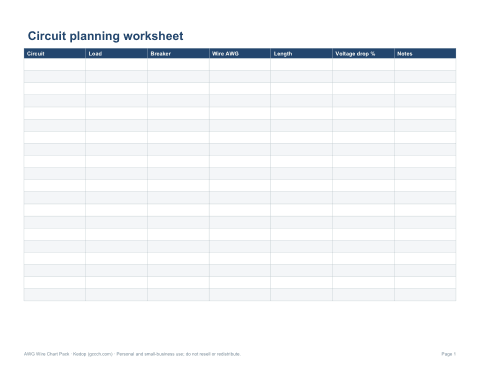
 Printable Circuit Planning Worksheet
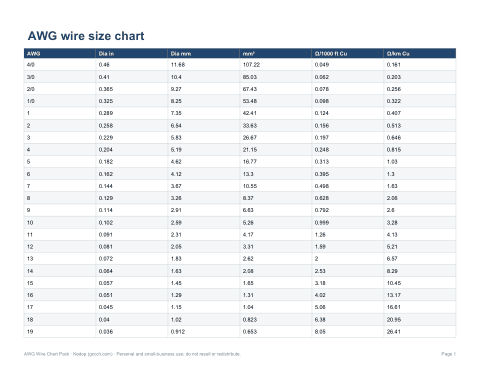
AWG wire size chart
| AWG | Diameter (in) | Diameter (mm) | Area (mm²) | Resistance Ω/1000 ft (Cu, 20 °C) | Ω/km |
|---|---|---|---|---|---|
| 4/0 | 0.4600 | 11.684 | 107.22 | 0.0490 | 0.1608 |
| 3/0 | 0.4096 | 10.405 | 85.03 | 0.0618 | 0.2028 |
| 2/0 | 0.3648 | 9.266 | 67.43 | 0.0779 | 0.2557 |
| 1/0 | 0.3249 | 8.251 | 53.48 | 0.0983 | 0.3224 |
| 1 | 0.2893 | 7.348 | 42.41 | 0.1239 | 0.4065 |
| 2 | 0.2576 | 6.544 | 33.63 | 0.1562 | 0.5126 |
| 3 | 0.2294 | 5.827 | 26.67 | 0.1970 | 0.6464 |
| 4 | 0.2043 | 5.189 | 21.15 | 0.2484 | 0.8151 |
| 6 | 0.1620 | 4.115 | 13.30 | 0.3950 | 1.296 |
| 8 | 0.1285 | 3.264 | 8.37 | 0.6281 | 2.061 |
| 10 | 0.1019 | 2.588 | 5.26 | 0.9988 | 3.277 |
| 12 | 0.0808 | 2.053 | 3.31 | 1.588 | 5.210 |
| 14 | 0.0641 | 1.628 | 2.08 | 2.525 | 8.285 |
| 16 | 0.0508 | 1.291 | 1.31 | 4.015 | 13.173 |
| 18 | 0.0403 | 1.024 | 0.823 | 6.385 | 20.947 |
| 20 | 0.0320 | 0.812 | 0.518 | 10.152 | 33.306 |
| 22 | 0.0253 | 0.644 | 0.326 | 16.142 | 52.959 |
| 24 | 0.0201 | 0.511 | 0.205 | 25.667 | 84.208 |
Diameters are for solid round wire from the standard AWG formula; stranded wire of the same gauge has a slightly larger overall diameter. Resistance is for copper at 20 °C and rises by about 0.4% per °C.
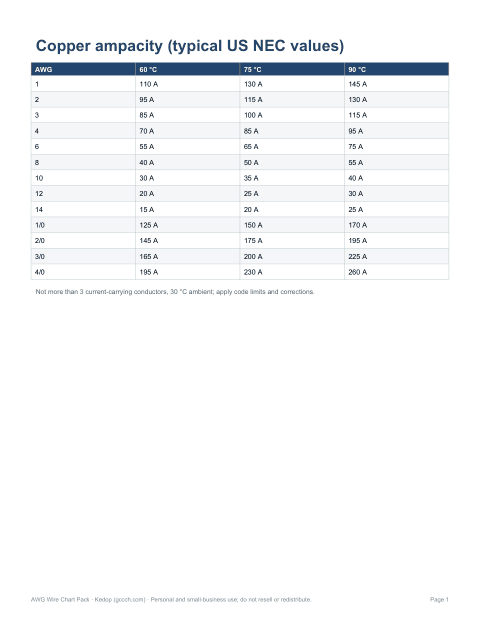
Typical copper ampacity (building wire)
| AWG | 60 °C | 75 °C | 90 °C | Common circuit use (US) |
|---|---|---|---|---|
| 14 | 15 A | 20 A | 25 A | 15 A lighting and receptacle circuits |
| 12 | 20 A | 25 A | 30 A | 20 A kitchen, bathroom and general circuits |
| 10 | 30 A | 35 A | 40 A | 30 A water heaters, dryers |
| 8 | 40 A | 50 A | 55 A | Ranges, larger A/C units |
| 6 | 55 A | 65 A | 75 A | Ranges, subpanels, EV chargers |
| 4 | 70 A | 85 A | 95 A | Subpanels |
| 2 | 95 A | 115 A | 130 A | Larger feeders |
| 1/0 | 125 A | 150 A | 170 A | Service and feeders |
| 2/0 | 145 A | 175 A | 195 A | Service entrance |
| 4/0 | 195 A | 230 A | 260 A | Service entrance |
These values follow the widely used US National Electrical Code table for copper conductors with not more than three current-carrying conductors in a raceway or cable at 30 °C ambient. Other rules limit how they are used — for example, overcurrent protection for 14, 12 and 10 AWG copper is typically limited to 15, 20 and 30 A — and corrections apply for temperature, bundling and the terminal ratings of connected equipment. Always follow the code in force where you are and the equipment instructions; electrical work may require a licensed electrician.
How AWG numbers work
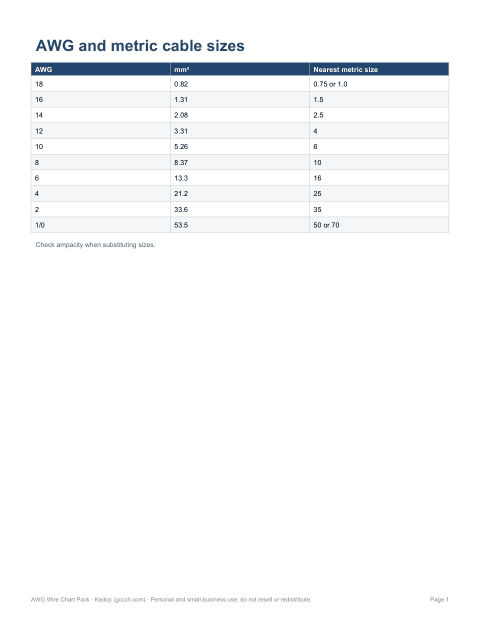
AWG comes from the number of drawing steps used to make the wire. Every 6 gauges, the diameter halves; every 3 gauges, the cross-sectional area (and conductance) roughly halves; and each single gauge changes the area by about 26%. Sizes larger than 1 AWG are written 1/0, 2/0, 3/0 and 4/0 (“one aught” to “four aught”), and above 4/0, wire is sized in kcmil (thousands of circular mils). Outside North America, cables are usually sized directly by cross-section in mm² — 1.5, 2.5, 4, 6, 10 mm² and so on.
Voltage drop
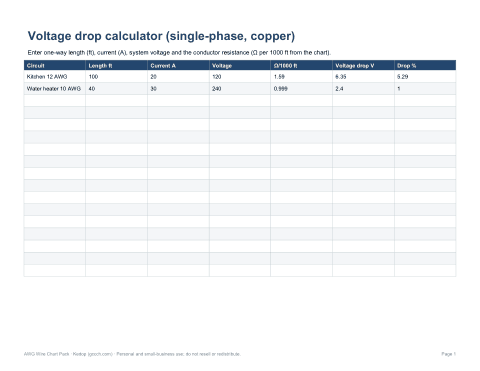
Long runs lose voltage in the wire. For a single-phase circuit, voltage drop ≈ 2 × one-way length × current × resistance per unit length. A common design goal is to keep voltage drop under about 3% on a branch circuit and 5% overall. Example: a 20 A load 100 ft from the panel on 12 AWG copper (about 1.59 Ω per 1,000 ft) drops 2 × 100 × 20 × 0.00159 ≈ 6.4 V — about 5.3% on 120 V, which suggests stepping up to 10 AWG (about 4 V, 3.3%).
Worked example: choosing a wire size
An electrician plans a 30 A, 240 V circuit for a water heater 40 ft from the panel. The ampacity table points to 10 AWG copper at 30 A with 60 °C terminations. Voltage drop is 2 × 40 × 30 × 0.000999 ≈ 2.4 V — 1% of 240 V — well within the usual target, so 10 AWG is suitable, subject to the local code and the heater’s instructions. For a 150 ft run to a detached garage, voltage drop would push the choice up a size or more.
Copper vs aluminium
Aluminium conductors have about 61% of the conductivity of copper, so an aluminium wire must be roughly two AWG sizes larger to carry the same current. Aluminium is common for large service and feeder cables because it is lighter and cheaper; it needs connectors and terminals rated for aluminium and correct installation to avoid loose connections.
What’s in the pack
- Printable AWG chart (diameter, area, resistance) for 4/0 to 30 AWG
- Copper ampacity reference card with circuit examples
- AWG to mm² conversion card
- Excel voltage-drop calculator and wire-size checker
- Circuit planning worksheet
Printables fit US Letter and A4; the spreadsheet opens in Excel and Google Sheets.
AI-assisted content
Charts were generated from the standard AWG formula and reviewed before publishing. They are reference information, not a substitute for the applicable electrical code.
Frequently asked questions
What does AWG stand for?
American Wire Gauge, the standard wire sizing system in North America.
Is a lower AWG number thicker?
Yes — 10 AWG is thicker than 14 AWG.
What wire size for a 20 amp circuit?
Typically 12 AWG copper for a 20 A branch circuit in US practice; check your local code.
What is 12 AWG in mm²?
About 3.31 mm².
What does 4/0 mean?
“Four aught”, a size larger than 1/0, 2/0 and 3/0 — about 107 mm².
Is this a subscription?
No, it is a one-time download.